
Everyone who calls a data recovery lab has the same first question, and every lab gives the same unsatisfying answer: it depends. This guide explains what it depends on, so you can tell a fair quote from a bad one, understand why two drives that look identical can be priced very differently, and know which decisions on your side move the price. We do not publish a price list, and this page explains why, without hiding anything else.
Price follows the failure, not the data
The amount of data does not set the price. A one gigabyte drive and a twenty terabyte drive with the same failure need the same repair, and only the imaging time differs. What sets the price is what has to be done to the drive before the data can be read. That falls into four tiers.
| Tier | What failed | What the work involves | Where it sits |
|---|---|---|---|
| Logical | Deleted files, accidental format, corrupted file system, lost partition, on a drive that is otherwise healthy | Imaging the drive, then rebuilding or searching the file system on the image | Lowest tier |
| Electronic and firmware | Burnt circuit board, failed component after a surge, corrupted firmware, wrong capacity, drive not identifying | Board repair or donor board with the drive’s own firmware chip transferred, or firmware modules repaired with specialist tools, then imaging | Middle tier |
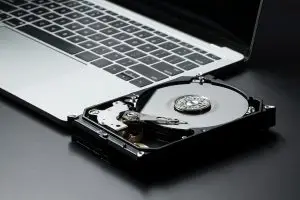
| Mechanical, cleanroom | Clicking, failed or stuck heads, seized spindle, scratched platters | Donor drive sourced, head stack or platters transplanted in the cleanroom, then careful imaging, often over several sessions | Highest tier for one drive |
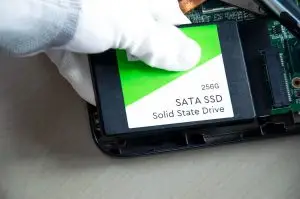
| Complex | SSDs needing chip-level reads, encrypted drives, RAID and NAS arrays, servers, virtual machines | Every member drive imaged, arrays rebuilt virtually, controllers emulated in software, encryption handled | Scales with drive count and complexity |
Most drives that arrive at our lab are in the first three tiers, and the seven failures behind them are described in our hard drive failure symptoms guide, including how to recognise each one before it moves to the next tier.
What moves the price up
- Previous recovery attempts. A drive that was opened at home, put in the freezer, run for hours by recovery software, or had its board swapped needs more work than the same drive brought in untouched. This is the most common reason a quote is higher than a client expected.
- Rare or old drives. Cleanroom work needs a matching donor. Common drives have donors on the shelf. A drive from a discontinued line may need one sourced from overseas.
- Platter damage. A clicking drive that was powered on many times may have scratches. Scratched platters mean more imaging passes, sometimes more than one head set, and lower odds.
- Multiple drives. Arrays and servers are priced per drive imaged plus the reconstruction, because every member has to be read in full.
- Encryption. Self-encrypting drives, BitLocker, FileVault, and encrypted NAS volumes add steps and, without the key or password, can make recovery impossible.
- Speed. Standard turnaround is 10 to 12 business days after you approve the quote. Faster options exist for an added fee, and they cost more because they jump the queue in a lab that runs one drive at a time on each imager.
What moves the price down
- Bringing it in early. A weak head imaged today is a middle-tier job. The same head, run for another week until it fails, is a cleanroom job. Nothing else on this list matters as much.
- Not attempting a fix. Every home procedure that fails adds work. Powering off and stopping is free.
- Knowing what you need. Recovering one folder of photos from a drive is sometimes less work than recovering everything, because imaging can be targeted. Tell us what matters most.
- Bringing the whole thing. The external enclosure, the power adapter, both drives of a Fusion Drive, all the drives of an array in order. Missing parts mean sourcing or guessing.
What is included, and what is not
- A free evaluation within 48 hours of receiving the drive
- A written quote before any work starts, which you approve or decline
- No data, no fee. If we cannot recover what you need, you do not pay for the attempt
- A free prepaid Canada Post waybill to send the drive from anywhere in Canada, and free return shipping after a successful recovery
- A backup copy of your recovered data held for one month after delivery
- Strict confidentiality, with the work done in our own lab in Langley, BC, by our own engineers
Recovered data is returned by secure download or on a drive. Ask about return media when you approve the quote so there are no surprises. Recovery does not include repairing the original drive; a recovered drive is retired, not reused.
Why quotes vary so much between companies
The data recovery market has a pricing problem, and it is worth understanding before you compare quotes.
- Bait pricing. Advertised starting prices that apply only to the simplest logical recoveries, followed by a much higher quote once the drive is in hand and you are committed.
- Shipping fronts. Some local storefronts have no lab. Your drive is shipped to a subcontractor, and the storefront’s margin sits on top of the real price. Ask whether the work is done on the premises.
- Evaluation fees and diagnostic deposits. Charged before you know whether anything is recoverable. A lab confident in its odds does not need them.
- Different definitions of no data, no fee. Some firms charge a reduced fee, a parts fee, or a return fee on a failed recovery. Ask what a failed attempt costs before you say yes.
- Different definitions of recovered. A folder of files with corrupted contents is not a recovery. Ask to see a file list and to open sample files before you pay.
Questions to ask any lab, including us
- Is the work done in your own lab, and can I visit it?
- Is the evaluation free, and what happens if I decline the quote?
- What exactly do I pay if the recovery fails?
- Do you have a cleanroom, and who does the mechanical work?
- Will I see a file list before I pay?
- Where does my drive physically go, and does my data leave Canada?
Our answers: the work is done at our Langley lab, which you can walk into on weekdays; the evaluation is free and declining costs nothing; a failed recovery costs nothing; we have a cleanroom and our own engineers; you see the file list first; and nothing leaves Canada.
Frequently asked questions
How much does data recovery cost?
It depends on what failed, not on how much data you have. A deleted file on a healthy drive is the lowest tier. A burnt circuit board or corrupted firmware is the middle tier. A clicking drive that needs a cleanroom head replacement is the highest tier for a single drive, and multi-drive RAID and chip-level SSD work sit above that. We do not publish prices because two clicking drives can be very different jobs. What we do publish is the process: a free evaluation, a written quote before any work, and no charge if we do not recover your data.
Why does cleanroom data recovery cost more?
Because it is surgery. A head replacement means sourcing a matching donor drive, often from a specific factory batch, opening both in a cleanroom, transplanting the head stack under magnification, and then imaging a drive that may only run for a short time. The donor parts alone can cost more than a new drive, and the hours are specialist hours. That is why the tier exists, and why avoiding it by bringing a drive in early is the single biggest thing you can do about price.
Is the evaluation really free?
Yes. We evaluate within 48 hours of receiving the drive and send a written quote. You approve it or you decline it, and if you decline, there is no charge for the evaluation. The one thing we ask is that the drive has not been opened at home, because an opened drive needs cleanroom time just to assess.
What does no data, no fee actually mean?
If we cannot recover the data you need, you do not pay for the recovery attempt. Not a reduced fee, not an evaluation fee, nothing. It also means the quote you approve is the price, and there are no surprises when the job finishes.
Can I get a price by calling?
Not an exact one, and be cautious of anyone who gives you one. Nobody can price a drive they have not tested. What we can give you online is a range: our free AI evaluation asks about the symptoms and tells you the likely failure tier and a typical range for it, in about two minutes. The written quote comes after the evaluation.
Does home or business insurance cover data recovery?
Sometimes. Some home policies cover data recovery after a covered event such as a power surge or flood, and some business and cyber policies cover it outright. We provide the written evaluation and invoice most insurers ask for. Check the policy or ask your broker before assuming either way.
Want a range before you commit?
The free AI evaluation asks what you see and hear and tells you the likely failure tier and typical range in about two minutes. Then the free lab evaluation gives you the written quote.
Instant AI EvaluationRequest a Free WaybillContact Us